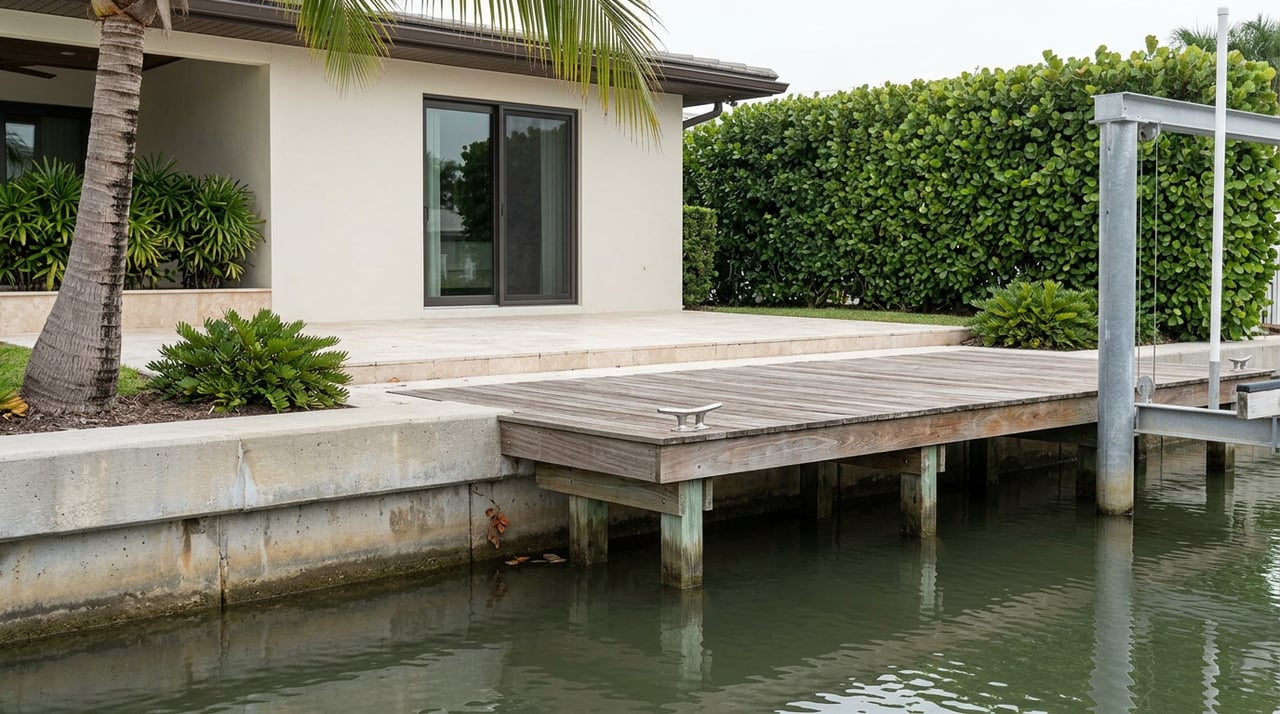
Two Royal Harbor homes can list at the same price, sit on canals of the same width, and still carry entirely different financial futures. One seller replaced the seawall two years ago. The other's cap is showing hairline cracks nobody photographed for the listing. A buyer comparing the two on paper would see identical numbers. A marine engineer would see a six-figure gap.
This is the part of Royal Harbor that portal data cannot show you, and it matters more than square footage, more than the pool, and more than whatever the listing description says about "unrestricted Gulf access."
What the median actually contains
As of June 2026, Royal Harbor's median list price sat near $3.95 million, with homes averaging about $1,661 per square foot and spending roughly 146 days on the market before selling. Condo inventory told a different story earlier in the year: in March 2026, units ranged from $374,900 to $2,895,000, with a median closer to $2,350,000 and an average sale price above $3 million, moving slightly slower at around 155 days.
That spread is wide even for a single Naples neighborhood, and the reason is structural rather than cosmetic. Royal Harbor was built out largely in the 1950s through the 1970s, and over the past fifteen years it has become one of the city's most active teardown-and-rebuild markets. New construction now regularly starts north of $6.5 million. Meanwhile, original mid-century homes and older condos in communities like Oyster Bay still trade for a fraction of that. The median is an average of two different housing stocks occupying the same zip code, which means it tells you almost nothing about what a specific property will actually cost to own.
The thing that actually sets the price
Royal Harbor's core appeal has never been the architecture. It's the water underneath the dock.
Every home in the neighborhood sits on a canal with a direct route to Naples Bay and, from there, to the Gulf of Mexico through Gordon Pass, with no fixed bridges in the way. That's a genuine structural advantage over many other Naples waterfront neighborhoods, where a low bridge clearance can rule out a boat with a fixed T-top, a tuna tower, or a sailboat mast. It's also the reason buyers who get priced out of Port Royal or Aqualane Shores, or who don't clear those communities' informal social requirements, have historically treated Royal Harbor as the practical alternative.
But "no bridges" does not mean "any boat, anywhere in the neighborhood." Canal depth varies significantly street to street. Wider, deeper canals, including stretches off Kingfish Road and bay-front positions directly on Naples Bay, can handle sailboats and larger sport fishers. Interior canals are often better suited to mid-size powerboats and center consoles. None of this shows up in a listing photo. It shows up when you try to bring your specific vessel home and discover the dock you bought doesn't fit the boat you own.
The number nobody mentions until the inspection period
Here is the finding that should change how you read every Royal Harbor listing: the seawall is not a maintenance item. It's a capital asset with a finite lifespan, and standard flood insurance does not cover it.
Three seawall types show up across the neighborhood. Poured concrete panel is the most common, durable when properly maintained but prone to horizontal cracking, leaning, and soil loss behind the cap as it ages or takes on storm surge. Steel or vinyl sheet pile holds up differently depending on material, since steel corrodes in saltwater over time while vinyl tends to last longer if installed correctly. Rip-rap rock or rubble shows up occasionally as a lower-cost option, though it offers less protection against significant surge.
The median price tells you what Royal Harbor houses cost. It does not tell you what they will cost.
Replacement runs roughly $300 to $1,200 or more per linear foot, depending on material, access, and permitting complexity. On a typical Royal Harbor lot, that spread compounds fast:
| Seawall length | Low-end replacement (~$300/ft) | High-end replacement (~$1,200/ft) |
|---|---|---|
| 75 feet | $22,500 | $90,000 |
| 100 feet | $30,000 | $120,000 |
| 150 feet | $45,000 | $180,000 |
Full failures on larger or more complicated frontages can run $50,000 to $300,000 or more once you factor in tiebacks, engineering, and permitting. None of that is optional once a seawall starts failing, and none of it is a line item a standard homeowner's or flood policy will pay for.
The smaller frictions that add up
A few other details rarely surface until a buyer is deep into due diligence.
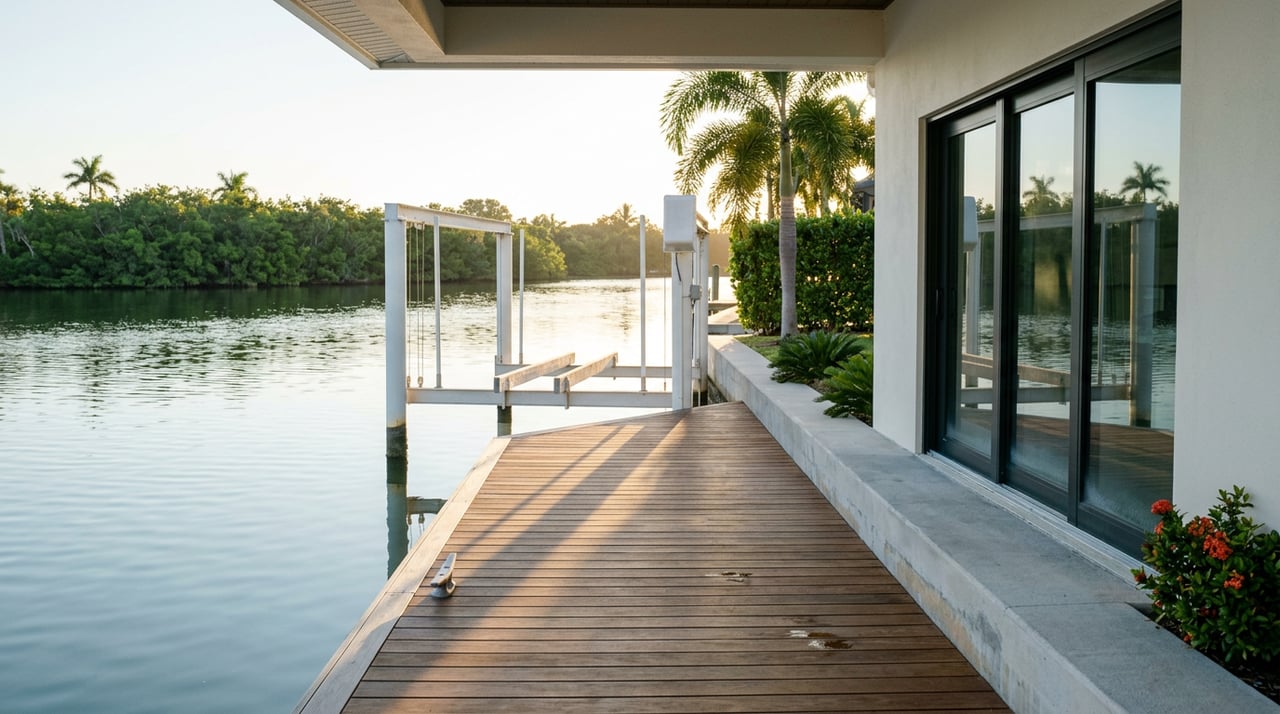
Boat lifts have rated capacities, and a lift rated for 10,000 pounds holding a 13,000-pound boat is a liability, not a convenience. Confirm the rated capacity against the actual weight of the vessel you intend to keep there, not the one the seller used.
Dock and lift work requires permits through the City of Naples or Collier County, plus a Florida Department of Environmental Protection review to confirm no impact on seagrass or protected habitat. The city currently charges a permit fee of $0.30 per square foot of structure on top of plan review costs, which is modest on its own but signals that any dock modification you're planning will take longer than a weekend.
And "bridge-free" does not mean unrestricted the entire way to open water. Manatee zones along the route through Naples Bay and Gordon Pass require slow or idle speed, which can meaningfully extend the time it actually takes to reach the Gulf, regardless of how fast your boat can go.
What this means if you're comparing neighborhoods
None of this makes Royal Harbor a worse choice than Port Royal, Aqualane Shores, or any other Naples waterfront community. It makes it a neighborhood where the real comparison happens below the waterline, not on the spec sheet.
Before writing an offer, request a marine or structural engineer's inspection of the seawall, not just a general home inspection. Pull permit and plan history for prior seawall or dock work through the county's e-permitting system to see what's actually been done versus what the listing claims. Verify controlling depth for your specific draft at low tide, since Naples Bay and Gordon Pass depths vary enough to matter for anything larger than a center console. And treat seawall condition the way you'd treat a roof: budget a reserve, not a hope.
Royal Harbor remains one of the more approachable ways to buy true bay-to-Gulf boating access close to downtown Naples. The value is real. So is the maintenance curve underneath it, and that's the part worth pricing in before you fall in love with the dock.
A few questions that come up often
Does "no bridges" apply to every home in Royal Harbor? The neighborhood as a whole routes to the Gulf through Gordon Pass without fixed bridges, which is a genuine advantage over many other Naples canal communities. What varies by street and dock is canal depth, so the no-bridge claim tells you about routing, not about whether your specific boat will clear the water at your specific dock.
Who's responsible for verifying seawall condition before closing? That falls to the buyer during the inspection period. A general home inspector typically won't assess a seawall's structural integrity the way a marine or structural engineer will, so it's worth commissioning that inspection separately and reviewing the county's permit history for the property.
Is there an HOA that covers shared amenities? Royal Harbor is not gated, and there's no mandatory homeowners association funding shared amenities like a clubhouse or pool. Many residents instead join Naples Bay Resort for that kind of access, which is worth factoring into your comparison if community amenities matter to your lifestyle.
If you're weighing Royal Harbor against other Naples waterfront neighborhoods and want a clearer read on what a specific dock, canal, or seawall actually means for your plans, Lynna Follis can walk through the details with you before you write an offer, not after.