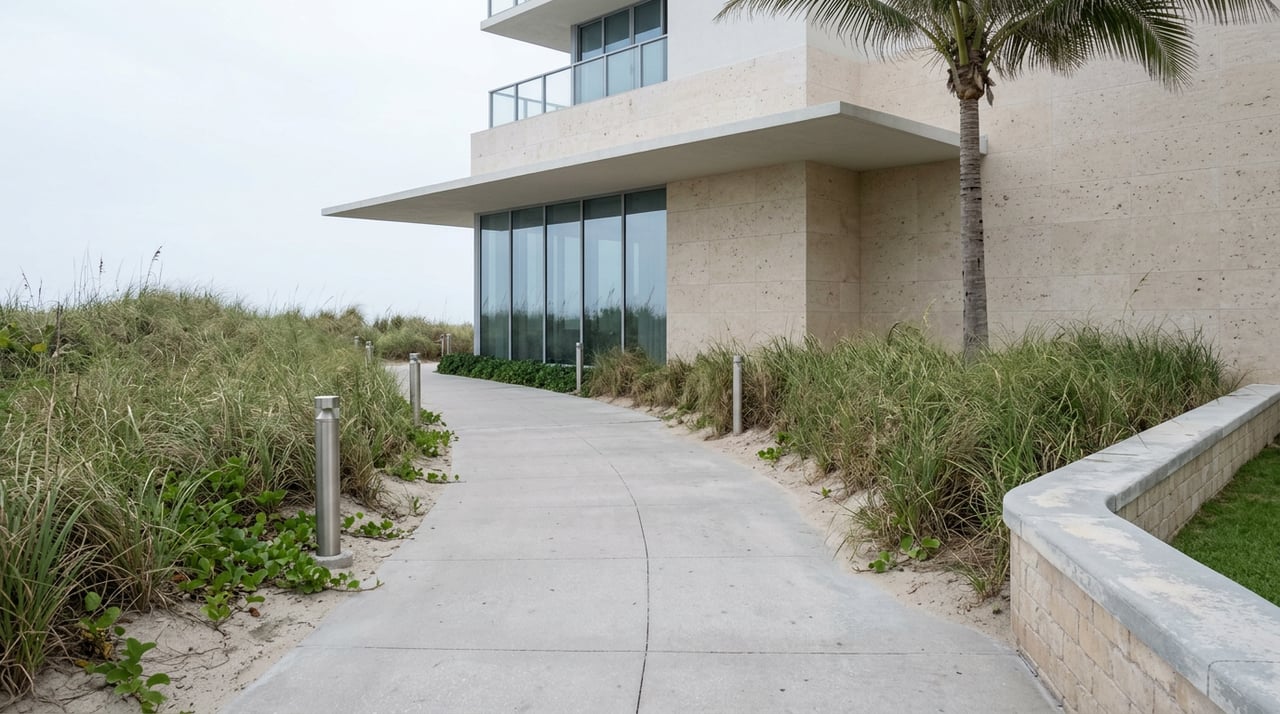
Walk the beach-walk south from LeParc on any morning this month and the concrete is smooth, the lighting fixtures are new, and the dune grass on your right has filled in enough to hide the sand fence behind it. Keep going toward Horizon House and at some point the surface changes. The grass thins. There is a stretch where the landscaping looks like it is still catching up to the rest of the path. Most people who walk it every day have a theory about why. Almost none of them are right.
The beach-walk that fronts the Gulf side of Park Shore is not one amenity built and maintained by one entity. It is a 1.2-mile chain of privately owned segments, stitched together by five separate condominium Commons associations, each making its own decisions on its own budget and its own timeline about a walkway that residents experience as a single, continuous thing. A few hundred yards inland, a sixth board runs a completely different beach amenity under a different gate, with its own calendar of events and its own multi-year list of upgrades. Nobody who uses either one day to day thinks of them as six separate governments. They are.
One Walk, Five Different Owners
The Gulf Shore Association of Condominiums, the umbrella group representing the Commons boards on the west side of Gulf Shore Boulevard North, describes the beach-walk plainly: it runs from Horizon House on the south end to LeParc on the north, built by the Lutgert Company in the early 1970s as part of the original master development. It is private property. Each Commons board along the route owns and maintains its own segment, and the Park Shore Association's own rulebook makes the boundary explicit: the sidewalk running north and south through condo frontage is owned and maintained by the condominium residents abutting it, and only those owners are permitted to use that stretch.
That detail matters more than it sounds like it should. It means the beach-walk was never designed as a single capital project with a single point of accountability. It is closer to five adjoining driveways that happen to line up into one visual path. When one Commons decides to resurface early, or fund new lighting sooner, or finish its dune planting ahead of schedule, the walk looks seamless in front of that building and abruptly unfinished at the next property line. The uneven stretch near the southern end of the route is not a mystery. It is what happens when five boards move at five different speeds toward the same repair.
What Four Years of Repair Actually Looked Like
The reason there was repair to do at all traces back to Hurricane Ian in 2022. A 14-foot storm surge broke the concrete along stretches of the walk that had stood since the 1970s. GSAC's own account of the rebuild, posted in April 2026, describes a job that was never going to be quick: Florida Department of Environmental Protection and City of Naples permits were required before anyone could pour new concrete. Coastal engineers, civil engineers, and landscape architects were retained. The new structure had to be built stronger than what it replaced. Lighting bollards had to meet turtle-friendly standards. Sea oats and railroad vine were chosen specifically because their root systems hold sand and help rebuild the dune the storm had stripped away. Underneath the northern half of the walk, oversized perforated stormwater pipes needed to be cleaned out as part of the same project. All of it had to work around turtle nesting season, which effectively pauses beachfront construction for months at a stretch each year.
By the time GSAC published that update, the association was willing to say that most of the area had been returned to its previous condition after almost four years of work. It was equally direct that the southern section still had work remaining. That is not a project that quietly wrapped up sometime in the past year. It is a project that is still, as of this writing, not finished everywhere, nearly four years after the storm that started it.
The Park Board Two Gates Over
The confusion most residents have is understandable, because Park Shore actually has two separate private beach amenities sitting close together, run by boards that do not answer to each other. The beach-walk belongs to the Commons associations. The Raymond L. Lutgert Beach Park, a 2.7-acre members-only park at 4061 Gulf Shore Boulevard North, belongs to the Park Shore Association, the membership group open to any residential property owner in the platted Park Shore subdivision, whether that means a condo, a villa, or a single-family home. The Lutgert family donated that land to the PSA in 1978, and in 2011 the family gave the park its sculpture, "Aspiration," by Raymond Lutgert himself.
Membership in the PSA runs an initiation fee plus annual dues totaling $1,300, and it buys access to a gated stretch of sand that operates on its own calendar. That calendar has been active this year. The PSA's February 12, 2026 annual meeting honored longtime member Jo Ann Smallwood with a lifetime membership for more than four decades of advocacy on behalf of Naples and Collier County's natural spaces. The same winter brought back Wine Wednesday, an evening gathering at the beach park timed to the sunset, and an Easter Egg Hunt for members and their families. Dune plantings of sea oats and native sea grasses installed in summer 2025 were, according to the association's own February 2026 update, thriving well enough to report on.
None of that is Commons business. The PSA runs its park, its events, and its own repair list. The Commons run the beach-walk. They coordinate on some things, most notably the resilience project described below, but they are not the same organization solving the same problem on the same schedule.
For residents who use the beach-walk as a daily loop rather than a straight there-and-back, the route is built around access points at five specific buildings: Meridian, Aria, Park Shore Tower, Brittany, and Le Ciel Venetian Tower. Combining those entry points turns a short stroll into a longer workout, something closer to a five-mile round trip for anyone willing to walk the full chain of segments end to end.
The Berm That Keeps Sliding Past Its Own Deadline
The rebuild that is mostly finished is not the last word on resilience. A separate, still-pending project would raise the promenade itself well above where it sits today. In front of the PSA's own beach park, the current elevation of the promenade is roughly six feet. The proposal on the table would more than double that height by building a substantial berm topped by the walkway, matching the elevated structure already in place north of the park. The case for it is not theoretical. According to the PSA's own account, properties that already sat behind higher berm levels came through Hurricanes Helene and Milton in 2024 with meaningfully less damage than those that did not.
But raising a beach-walk that belongs to five separate Commons boards, in front of a park that belongs to a sixth organization, is not a project one entity can simply approve and fund. PSA Board President Nancy Walkenhorst has been sitting in on the Commons discussions specifically to keep the association's plans aligned with whatever framework the Commons representatives eventually settle on. As of the association's most recent progress update, the project still needed sign-off from the Florida Department of Environmental Protection and the City of Naples, plus financial commitments from the Commons boards whose segments would be affected. An earlier planning page had already conceded that the berm, if approved, would not be ready before 2026. That timeline has not visibly moved since.
This is the same governance pattern showing up twice. The reason one stretch of the walk still looks unfinished after four years and the reason the resilience upgrade keeps sliding past its own target date are the same reason: no single board can move the whole 1.2 miles at once, because no single board owns it.
What This Means for the Way You Walk It Now
None of this changes what the beach-walk is on an ordinary morning: a long, mostly repaired, genuinely pleasant stretch of private walkway with real dune recovery to show for the work already done. It does mean that the rough patch you notice near the southern end is not a maintenance oversight so much as a visible seam between two boards moving at different speeds, and that the taller, sturdier version of the walk everyone has been hearing about is still working its way through permitting rather than sitting on a construction calendar. If you are the kind of resident who tracks these things, the honest answer to "when will it all match" is that it depends on five boards and a state agency arriving at the same page, and that has taken years so far, not months.
If you are weighing a move to Park Shore, or already live here and are thinking about what a property along this stretch is really buying into, it helps to talk with someone who follows these details as they change rather than repeats what was true two seasons ago. Lynna Follis has spent more than 25 years working Naples' waterfront neighborhoods and can walk you through what a specific building's Commons board has actually done, and has not yet done, before you make a decision. Let's Connect.