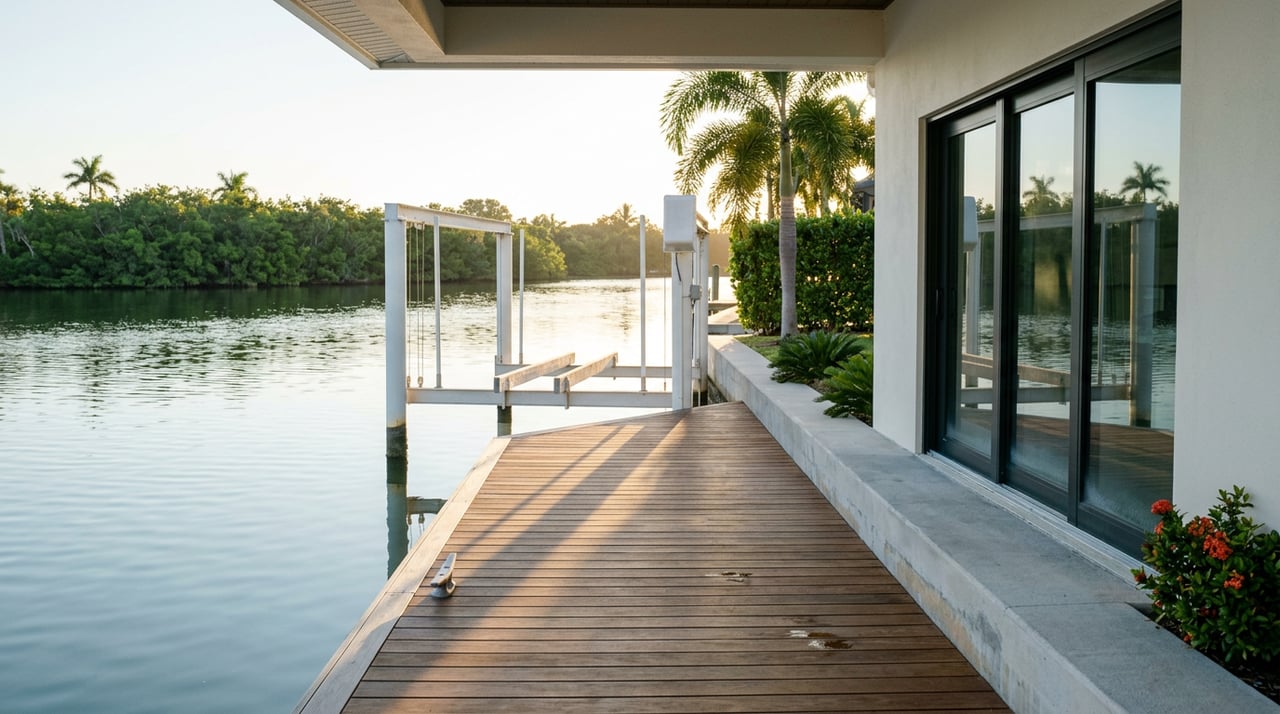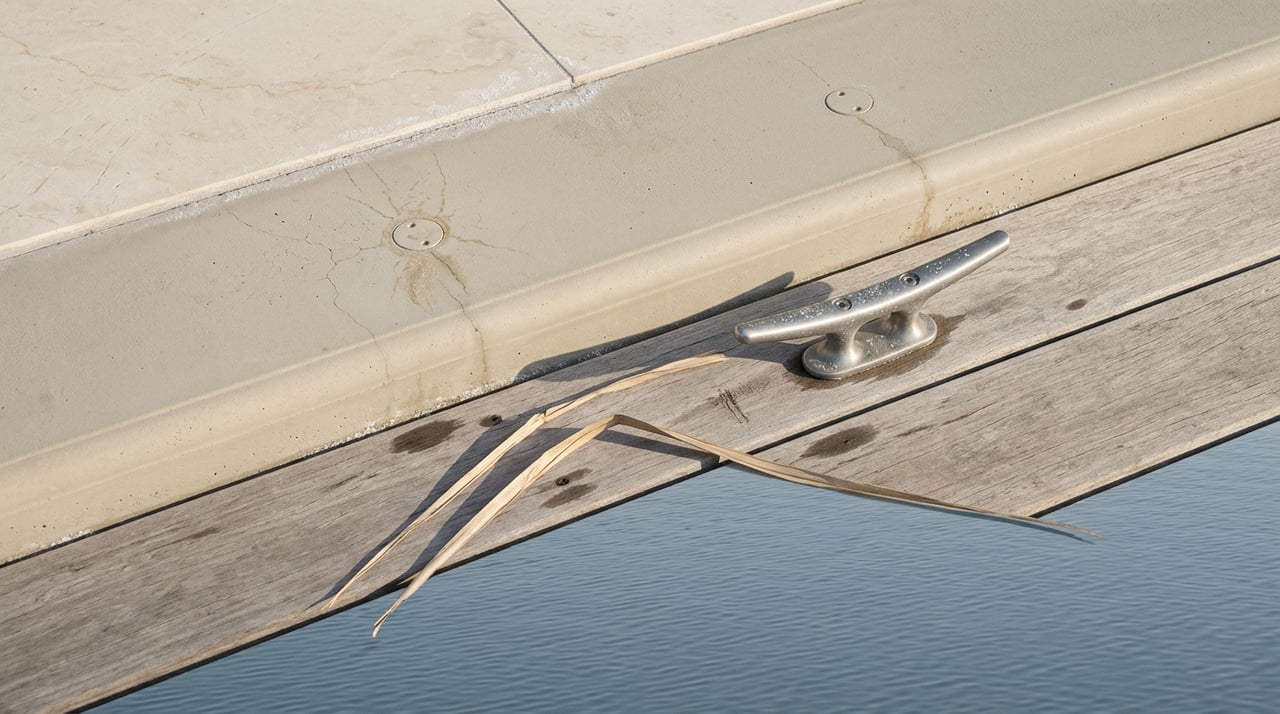
A buyer touring a wide-water lot in Port Royal this fall is usually doing the same math: more frontage, more canal, room for whatever boat comes next. That math is wrong, and it is wrong in a way that has nothing to do with the price on the listing sheet. Port Royal's own dock rules cap how far a structure can extend from the seawall at 22 feet, with a 100-linear-foot ceiling on any single or combined dock and roughly 20 feet of side setback on each edge of the parcel. A 32-foot boat with a 10.5-foot beam already claims most of that 22-foot allowance. The water frontage a buyer is paying for and the dock that frontage will actually support are two different numbers, and only one of them is negotiable.
That gap between what a lot looks like and what it can legally hold is the real story in Port Royal right now, and it matters more this year than it has in a while.
The permit stack starts before the dock
Nothing about waterfront work in Port Royal runs through a single office. A seawall repair, a new dock, or a boat lift touches the City of Naples for a marine permit, Collier County for a building permit covering any structure below the mean high water line, and the Florida Department of Environmental Protection for anything seaward of the Coastal Construction Control Line or involving state submerged lands. If the project involves dredging or sits inside a federally designated navigable channel, the U.S. Army Corps of Engineers gets added to the list. Layered on top of all of it, the Port Royal Property Owners Association reviews exterior modifications independently of any government approval, with its own focus on keeping sightlines and architectural character consistent across the neighborhood.
Timelines vary by agency, and they do not run at the same speed. County building permits for waterfront work typically clear in three to six weeks. FDEP review of the same seawall or dock project commonly takes three to six months. An owner who assumes the county timeline applies to the whole project is planning around the wrong number by a factor of four or five.
| Permit layer | Who administers it | What triggers it | Typical timeline |
|---|---|---|---|
| City marine permit | City of Naples | Seawall or dock work within city limits | Weeks, administrative |
| County building permit | Collier County Growth Management | Structural work below mean high water (seawalls, docks, lifts) | Roughly 3 to 6 weeks |
| Coastal construction review | Florida Department of Environmental Protection | Work seaward of the CCCL or in state waters | Roughly 3 to 6 months |
| Federal coordination | U.S. Army Corps of Engineers | Dredging or work in a navigable federal channel | Added months, project dependent |
| Architectural review | Port Royal Property Owners Association | Any exterior change, new construction, roofing, or landscaping | Runs alongside government review, often submitted first |
Contractors who work Port Royal regularly file the county and state applications concurrently rather than waiting on one before starting the other, because running them in sequence can add months to a project that already has months built into it.
The line that doesn't care about your lot line
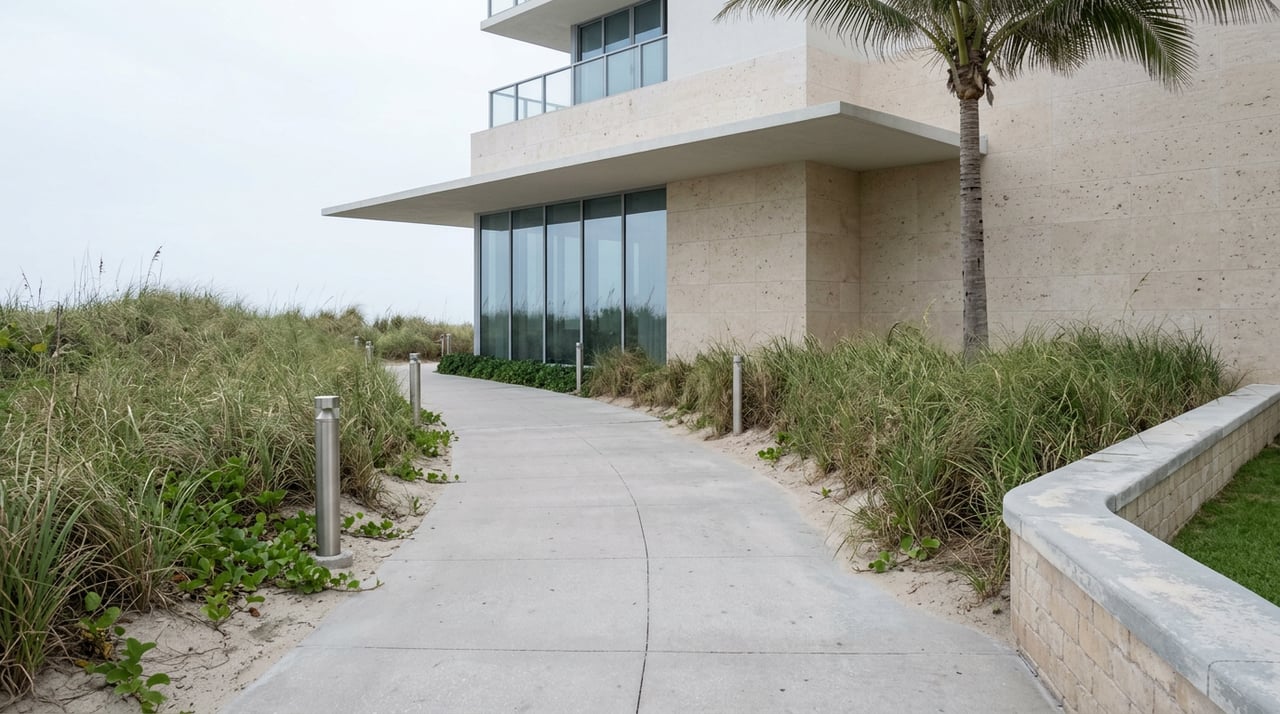
Florida established the Coastal Construction Control Line in Naples on June 28, 1989, under state statute, as a boundary meant to protect the beach and dune system from storm damage, not to track individual property lines. That distinction matters for buyers because a house can sit fully landward of the CCCL and still trigger permit review for a pool deck, a driveway extension, or shoreline landscaping that crosses it. A CCCL permit does not substitute for a building permit, and a building permit does not substitute for CCCL approval. Both are required independently, and the buildable envelope on a given lot can shrink once setbacks, easements, and the mapped CCCL line are all applied, sometimes to the point where an architect responds with a smaller footprint or an elevated, cantilevered design just to fit the remaining space.
The only way to know where that line actually falls on a specific parcel is a current survey checked against the state's mapping. A listing photo of open lawn between a house and the water does not tell a buyer whether that lawn is buildable.
What the seawall is actually worth protecting
Many of Port Royal's seawalls date to the 1960s and 1970s, which puts them at 50 to 60 years of service in a saltwater tidal environment that is harder on concrete than most of Florida's coastline. Heavy boat wake in Port Royal's narrower canals concentrates wave energy on the panels themselves, accelerating cap cracking and tieback failure over time. Concrete and well-built sheet-pile systems generally run 30 to 50 years before they need major work, which means a wall installed during Port Royal's original build-out is already living on borrowed time even where it looks intact from the yard.
The cost difference between catching a problem early and letting it become a structural failure is significant. Minor cracking or early tieback distress is typically repairable for a fraction of what full replacement runs, and a repair done while the wall is still sound can add another 20 to 30 years of service life. A wall that has progressed to a bowed face, an undermined foundation, or widespread cap failure is a different and far more expensive conversation, and one that will surface during any competent inspection before closing.
Why this matters more with 25 homes on the market
Southwest Florida MLS data covering the twelve months ending April 30, 2026 recorded 22 closed single-family sales in Port Royal at an average price above $21 million, with active inventory contracting 31 percent to just 25 homes. A separate report drawing on Naples Area Board of Realtors data for the twelve months ending January 2026 put Port Royal's price per square foot at $3,719, the highest in Naples and up more than 40 percent year over year, with inventory narrowing from a peak near 44 homes in 2024 to fewer than 30. By July 2026, the month's highest-priced sale in all of Naples was a $41.18 million Port Royal waterfront estate, and every one of the city's ten highest-priced closings that month sat in Port Royal, Old Naples, or Aqualane Shores.
Those numbers describe a market where the next comparable listing is not around the corner. When inventory sits in the mid-twenties and price per square foot is setting records, a buyer who discovers seawall or permitting problems after signing has far less room to simply move on to another lot with similar water access. The diligence that used to be a formality when 40-plus homes were on the market is now the difference between negotiating from strength and negotiating from a position where walking away costs real opportunity, not just a delay.
For a seller, the same math cuts the other way. Gathering permit history, engineering reports, and a current elevation certificate before listing removes the single most common source of late-stage renegotiation on a waterfront estate, and in a market this tight, a clean file is itself a competitive advantage.
A few questions that come up often
Does owning waterfront land in Port Royal mean I can build any dock I want? No. The neighborhood's legacy dock guidelines cap protrusion at 22 feet and total dock length at 100 linear feet regardless of how much water frontage the parcel has, and side setbacks of roughly 20 feet apply on top of that.
If my house sits landward of the CCCL, do I still need a coastal permit? Often yes, for site work that touches the regulated area. The CCCL governs activity, not just the house footprint, so pool decks, landscaping, and driveway work near the mapped line can still require review even when the main structure is unaffected.
How long should I expect a seawall or dock permit to take from start to finish? Plan for the state review, not the county one, to set your timeline. County building permits often clear in three to six weeks, but FDEP review for the same waterfront work commonly runs three to six months, and an experienced project team files both at the same time rather than waiting on one before starting the other.
If you are evaluating a Port Royal estate and want the seawall, dock, and permit history reviewed before you write an offer, not after, Lynna Follis can walk through what a specific lot's water line actually allows. Let's connect.